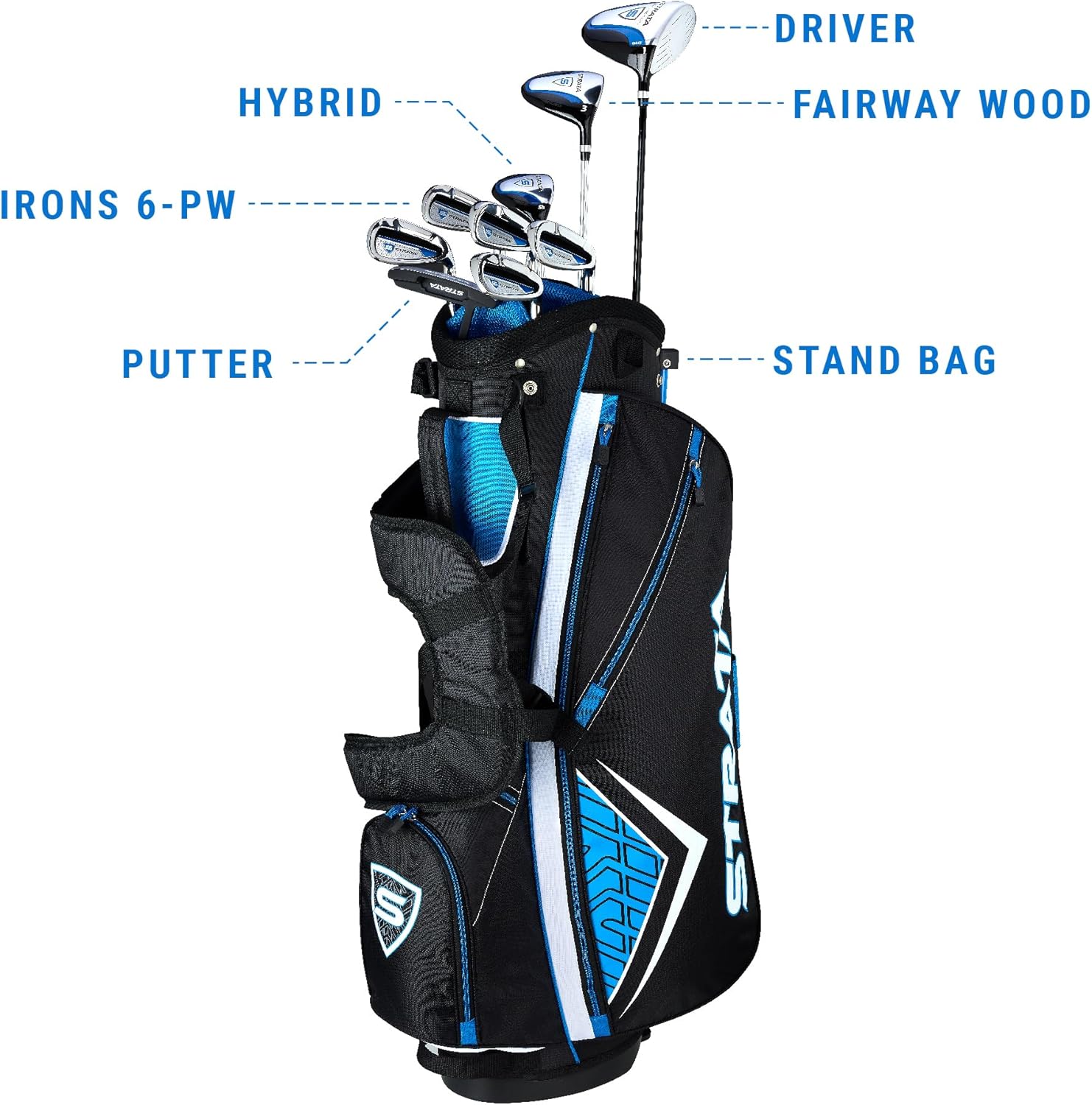
Picking your first complete set of golf clubs is one of those purchases that feels simple until you’re standing in a golf shop or scrolling a product page wondering what half the words mean. A “complete set” is exactly what it sounds like — a bundled package of all the clubs a beginner needs to play a full round, usually including a driver (the big club used for long shots off the tee), a fairway wood, a hybrid or two (versatile clubs that blend the ease of an iron with the distance of a wood), a set of irons (numbered clubs for mid-range shots), a pitching wedge (for shorter approach shots), and a putter (for rolling the ball into the hole on the green). Most packages also include a bag. The appeal is obvious: one purchase, everything included, no agonizing over individual clubs. But not all complete sets are worth your money, and the $280–$460 price range specifically contains both excellent beginner-friendly options and a fair number of sets you’ll want to replace within a year. This guide will help you know the difference.
| EDITOR'S PICK[Callaway Golf Strata Complete G](https://www.amazon.com/dp/B07H29Z4Y2?tag=greenflower20-20)… | Mid-tier[Callaway Golf Strata Complete G](https://www.amazon.com/dp/B07H2HQJR5?tag=greenflower20-20)… | Budget pick[Callaway Golf Strata Complete G](https://www.amazon.com/dp/B0B9P35NLH?tag=greenflower20-20)… | |
|---|---|---|---|
| Hand orientation | Left | Right | Right |
| Number of pieces | 12 | 12 | 9 |
| Gender | Men's | Men's | Unisex |
| Price | $384.99 | $379.99 | $279.99 |
| See on Amazon → | See on Amazon → | See on Amazon → |
Why the $280–$460 Range Is a Real Decision Zone — Not Just a Budget
Here’s the honest framing: below $280, most complete sets use materials and manufacturing tolerances that actively make it harder to learn the game. Cheap cast irons with inconsistent face thickness, shafts that flex unpredictably, and grips that slip in humid conditions all create bad feedback loops. A beginner can’t tell if a poor shot is their fault or the club’s fault, and that ambiguity slows improvement.
Above $460 — moving into the $600–$900 range — you’re entering individually sold club territory, where a fitting conversation starts to matter. At that price, buying a bundled complete set is usually a worse value than selecting your driver, irons, and putter separately based on your actual swing speed and ball flight tendencies.
That leaves $280–$460 as a legitimate sweet spot: durable enough to give real feedback, forgiving enough for swing development, and priced so that when you do improve and want to upgrade one club at a time, you haven’t over-invested.
By the numbers:
| Price tier | What you’re actually buying |
|---|---|
| Under $200 | Entry-level materials; inconsistent forgiveness; likely to replace in 6–12 months |
| $280–$460 | Decent steel or lightweight graphite shafts; consistent cavity-back irons; real bag included |
| $500–$650 | Overlap zone: individual club upgrades start to beat bundled value |
| $650+ | Fitted individual clubs; complete sets rarely worth it at this tier |
Per Golf Digest’s annual complete-set buying guide, the clearest signal that a set is worth the money in this range is the iron construction: look for cavity-back irons (where the back of the club head is hollowed out to redistribute weight to the perimeter), which are more forgiving of off-center hits than muscle-back or blade-style irons.
The Tradeoffs That Actually Matter at This Budget
Most buyers in this range are comparing three or four sets that look similar on paper. Here are the tradeoffs worth naming explicitly, because the spec sheets won’t surface them.
Graphite shafts vs. steel shafts
Shafts are the long tubes connecting your hands to the club head. Graphite shafts are lighter and dampen vibration, making them easier on the joints and slightly more forgiving for players with slower swing speeds (typically under 85 mph with the driver). Steel shafts are heavier, more consistent in their flex profile, and historically preferred as players develop feel. In the $280–$460 range, most sets offer graphite shafts in irons as a standard or upsell option. Golf Monthly’s beginner set roundup consistently recommends graphite irons for players who haven’t yet established a repeatable swing, noting that the weight savings can actually help you swing more freely while you’re learning.
The tradeoff: graphite irons in this range are often made to a looser tolerance than premium-tier graphite. They’re fine for a beginner but won’t carry over as performance equipment if you improve quickly.
Set composition: what clubs are actually in the box
A complete set that includes a 3-iron sounds impressive. It isn’t. Per Plugged In Golf’s complete-set review framework, a 3-iron or 4-iron in a beginner package is essentially a throw-in — these are the hardest clubs in the bag to hit and have no place in a new player’s bag. The better-value sets replace long irons with hybrids, which are easier to hit from the fairway and rough. When you’re evaluating sets in this range, compare the hybrid count, not the iron count. A set with a 5-iron through pitching wedge plus two hybrids is practically more useful than one that advertises a full 3-through-pitching-wedge iron set.
The bag: actually matters
The stand bag included with most sets in this range varies from genuinely useful to a liability. A bag with a functional dual strap (two straps to distribute weight across both shoulders rather than one shoulder), a rain hood, and at least four pockets is worth having. A single-strap bag with one pocket is going to frustrate you on every round. This is a minor point but an overlooked one — reviewers at Plugged In Golf note that bag quality is one of the most consistent differentiators between sets at the same iron quality and price.
Brand name vs. off-brand
In the $280–$460 tier, you’ll encounter sets from major OEM brands (Callaway, TaylorMade, Cleveland, Wilson, Cobra) and from white-label or entry-level brands. The honest assessment: the major brands at this tier aren’t making their best technology available — these are purpose-built beginner packages — but their quality control and shaft sourcing are meaningfully better. MyGolfSpy’s most-wanted complete set evaluations have consistently found that recognized-brand sets show tighter loft and lie angle consistency across a set of irons, which matters when you’re trying to figure out what each club does.
If X, Then Y: A Decision Framework for This Range
This is where buyers in this price window get stuck the longest. Here’s a clean decision tree based on the tradeoffs above:
If you’re genuinely just trying golf for the first time — you’ve played fewer than five rounds, you’re not sure the game will stick — spend toward the lower end ($280–$330). Wilson, Cleveland, and Callaway all have sets in this range that include a real bag, graphite irons, and a playable driver. You’re not leaving money on the table by spending less; you’re buying the right level of commitment for where you are.
If you’ve played 5–20 rounds and are starting to take lessons — the feedback loop from equipment starts to matter. Spend in the $350–$460 range and prioritize a set with two hybrids instead of long irons, graphite irons in the 5-iron-through-wedge range, and a driver with a loft between 10.5° and 12° (higher loft is more forgiving for slower swing speeds and gets the ball in the air more reliably). At this point, owners in long-run reviews consistently report that a slightly heavier, better-quality driver makes a noticeable difference in how consistently they can find the fairway.
If you expect to improve quickly — you’re athletic, you’re taking regular lessons, you have a friend or instructor who can give you honest feedback on your swing — consider spending $460 and treating the irons and hybrid as temporary. Budget to replace your irons with a better individual set within 18–24 months. The driver and putter from a quality complete set at this range can often stay in your bag longer, since driver forgiveness and a reliable putter are valuable at any level.
If someone is buying this as a gift — lean toward the middle of the range ($360–$420), prioritize a set from a recognized OEM brand, and make sure it’s the right-hand or left-hand configuration before purchasing. Returns on golf sets are cumbersome because of the bag and the number of individual clubs.
One Thing Most Beginners Get Wrong
The single most common mistake in this purchase category isn’t overspending on shafts or ignoring hybrid count — it’s buying a men’s regular-flex set for a player who should be in a senior or ladies flex, or vice versa. Shaft flex refers to how much the shaft bends during the swing; a shaft that’s too stiff for your swing speed will produce weak, low shots to the right (for a right-handed player), while a shaft that’s too flexible can balloon the ball too high and create inconsistency.
The USGA doesn’t regulate shaft flex labels — “regular,” “senior,” and “ladies” are manufacturer designations with no standardized definition across brands. Per Golf Digest’s shaft explainer content, a rough practical guide: players who swing a driver under 75 mph typically benefit from a senior or ladies flex; 75–90 mph suits regular flex; above 90 mph is where stiff flex begins to matter. Most complete sets in the $280–$460 range are sold in a single flex (usually regular for men’s sets, ladies flex for women’s sets), which works for most beginners — but it’s worth knowing what you’re getting.
What to Expect After You Buy
A complete set in this range should last a dedicated beginner two to four years before the equipment becomes a limiting factor — and that’s a reasonable runway. Golf Monthly’s multi-year tracking of beginner equipment notes that most players who improve to a 20-handicap or better within two years are ready for fitted individual irons, a standalone driver fitting, and a purpose-built putter. At that point, the complete set served its purpose.
The practical upgrade path looks like this: irons first (because that’s where the most rounds are played and the most learning happens), then driver once you have enough swing consistency for a fitting to mean something, then wedges and putter as your short game becomes more intentional. None of that is urgent at the beginning. For the first year of the game, the best equipment decision is the one that gets you on the course and keeps you there.
Spend in this range with clear eyes about what you’re buying: a learning tool, not a performance system. The players who regret these purchases almost always made one of two mistakes — they bought too cheaply and got equipment that actively frustrated their improvement, or they bought too expensively and invested in gear before they knew what they actually needed. The $280–$460 range, chosen carefully, avoids both.