A launch monitor is a device — about the size of a baseball or a paperback book, depending on the model — that measures what your golf ball and club are doing at the moment of impact. It captures data like ball speed (how fast the ball leaves the face), launch angle (the initial upward angle of flight), and spin rate (how fast the ball is rotating, which controls curve and distance). For anyone building a home simulator or trying to understand their swing beyond guesswork, that data is the difference between practicing with a mirror and practicing with a flight computer. This guide compares three devices that sit in the $350–$1,000 window as of mid-2026: the Garmin Approach R10, the FlightScope Mevo Gen2, and the Uneekor EYE MINI. Each one targets a different buyer, and getting that match right matters more than the specs themselves.
If you already know what doppler radar and photometric tracking mean — skip ahead. If not: doppler radar bounces radio waves off the ball to track its movement through the air, while photometric (or camera-based) systems photograph the ball and clubface at the moment of impact and calculate metrics from those images. Both approaches work. They just work differently, and that difference drives most of the tradeoffs below.
| EDITOR'S PICKFlightScope Mevo Gen2 Portable… | Mid-tierGarmin Approach R10 Portable Go… | Budget pickGarmin 010-02356-00 Approach R10 | |
|---|---|---|---|
| Data Parameters | 18 | — | — |
| Simulation Courses | 8 E6 courses | 43,000+ courses | — |
| Battery Life | — | — | Up 10 hours |
| Front Camera | ✓ | — | — |
| Video Recording | — | ✓ | — |
| Price | $1,299.00 | $409.99 | $349.99 |
| See on Amazon → | See on Amazon → | See on Amazon → |
The Decision Frame: What Are You Actually Building?
Before running the numbers, answer this question honestly: Is this primarily a data tool, a simulation platform, or both?
That single question separates these three devices more cleanly than any spec comparison.
The Garmin R10 is built for golfers who want feedback on the range or in the backyard — people who need directional data, shot shape, and enough distance information to improve without committing to a full indoor room. It is the most portable of the three and the least expensive.
The FlightScope Mevo Gen2 occupies a legitimate middle ground: good enough for a basic simulator build, accurate enough for a serious fitter’s first device, and portable enough to use outdoors. In their review of the Gen2, Plugged In Golf noted that the second-generation unit improved meaningfully on the original Mevo’s outdoor accuracy, particularly on spin metrics — a gap that mattered at this price point.
The Uneekor EYE MINI is a different animal entirely. It is a ceiling-mounted, camera-based system. Once it is installed, it does not move. That permanence is the point — it is the entry point to Uneekor’s photometric ecosystem, the same core technology their higher-end EYE XO and REFINE lines use. Coverage from GolfWRX in their “Uneekor EYE MINI First Look” piece framed it as the most professionally adjacent option under $1,000, specifically because overhead mounting eliminates the setup variables that trip up radar units in a permanent bay.
If you are renting your space or need to practice outdoors, the EYE MINI is a non-starter. If you own your space and are building a dedicated room, it becomes the most defensible choice in this tier.
Side-by-Side Specifications
| Garmin R10 | FlightScope Mevo Gen2 | Uneekor EYE MINI | |
|---|---|---|---|
| Street price (May 2026) | ~$599 | ~$749 | ~$999 |
| Tracking method | Doppler radar | Doppler radar | Dual-camera photometric |
| Mounting | Portable (ground/tripod) | Portable (ground/tripod) | Ceiling-mounted (permanent) |
| Primary use case | Range / backyard data | Range + entry simulator | Dedicated home simulator |
| Subscription required? | Yes (Garmin Golf app) | Optional (FS Golf app) | Yes (Uneekor software) |
| Club data (path, face angle)? | Estimated | Estimated | Measured directly |
Device-by-Device Breakdown
Garmin Approach R10
The R10 delivers a wide set of metrics — ball speed, launch angle, carry distance, shot shape, and estimated spin — in a device that fits in a jacket pocket and retails around $599. MyGolfSpy, in their annually updated “Best Launch Monitors: Tested and Ranked” guide, has consistently positioned the R10 as a strong value for outdoor use, with the key caveat that spin numbers are estimated by the device’s algorithm rather than directly measured. In practice, carry distance figures hold up reasonably well for most players, but spin-based feedback — the kind you would use to dial in a wedge trajectory or confirm a fitting change — carries more uncertainty than the readout implies.
The R10 connects to Garmin’s proprietary golf app, which requires a subscription (approximately $10–$15 per month or $100 per year for full feature access as of mid-2026, including virtual rounds). That ecosystem is self-contained: you get Garmin’s simulation environment and Garmin’s data dashboards, which is a reasonable trade if those tools meet your needs. Flexibility to third-party platforms is limited.
Best for: Golfers who want portable, on-range feedback and a tight budget. Not recommended as the primary device in a full simulator build where spin accuracy compounds into visible ball-flight errors in software.
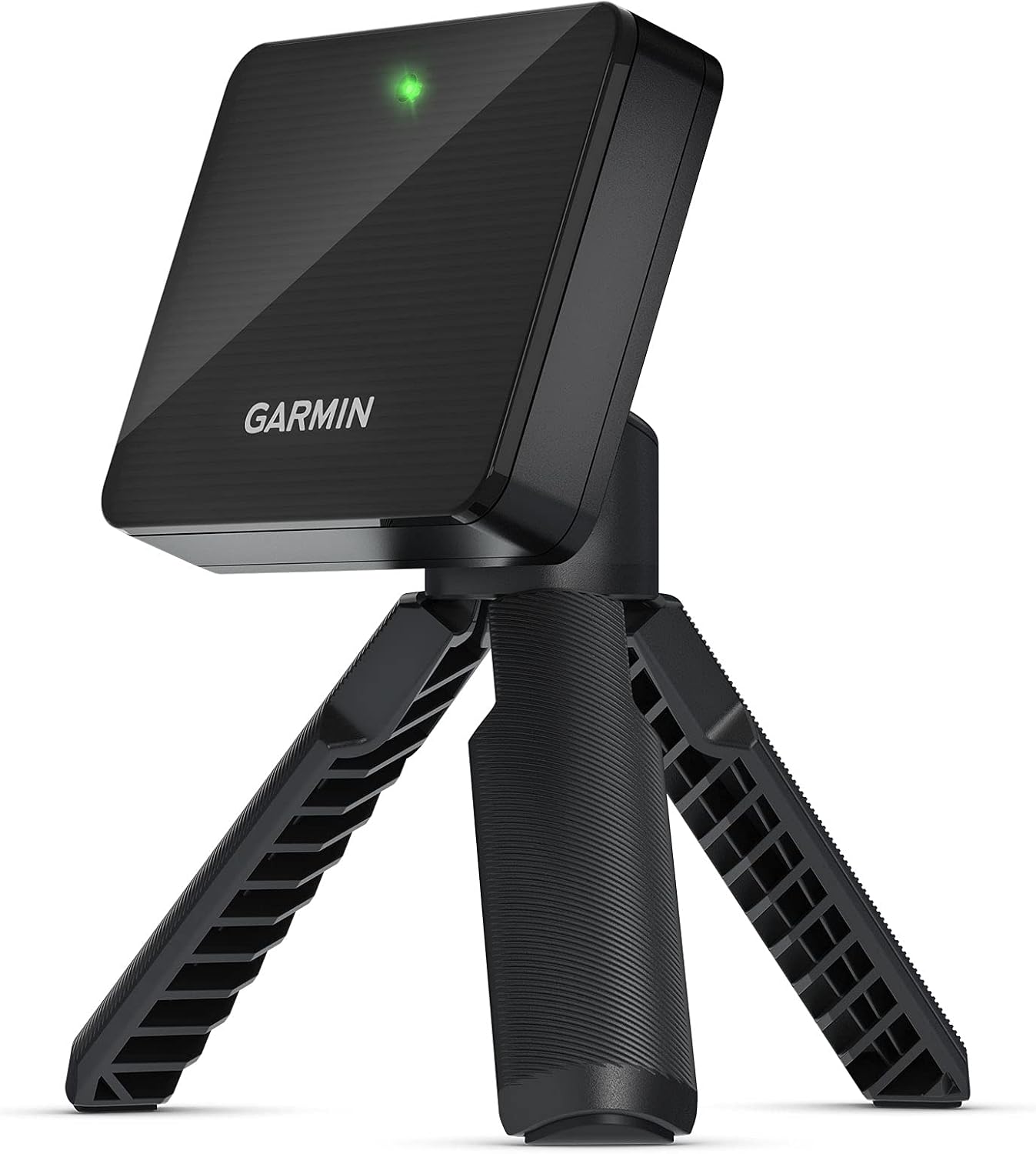
Garmin
$349.99
In stock on Amazon
Check price on AmazonFlightScope Mevo Gen2
The Mevo Gen2 sits at approximately $749 and earns its price premium over the R10 primarily through two upgrades: direct spin measurement and more flexible software integration. Where the R10 estimates spin, the Gen2 measures it — and that distinction matters the moment you start connecting the device to simulation software, because those platforms use spin as a primary input for virtual ball-flight calculation. Errors in spin input compound into ball-flight behavior that feels disconnected from the shot you actually hit.
Plugged In Golf’s “FlightScope Mevo Gen2 Review” documented tighter spin consistency in the Gen2 versus the original Mevo, with particular improvement in outdoor conditions where wind and ambient light had previously introduced variance. The Gen2 is still a radar device, meaning clubface data — path, face angle, impact location — is estimated rather than measured, but for most sim builds and informal fitting sessions, the spin and speed data fidelity is sufficient.
The software story is the Mevo Gen2’s strongest competitive advantage over the R10. The base FS Golf app is available without a recurring fee for range-mode data. Full simulator integration — connecting to E6 CONNECT, TGC 2019, or other platforms — routes through those platforms’ own subscriptions, typically $200–$350 per year depending on the tier. That flexibility means you are not locked into a single ecosystem, and it makes the Gen2 the most credible portable simulator device in this price window.
Best for: Golfers building a first home simulator in a garage or spare room where ceiling mounting is not practical. Also the most defensible entry-level choice for fitters running outdoor assessments, with appropriate caveats disclosed to clients.
Garmin
$409.99
In stock on Amazon
Check price on AmazonUneekor EYE MINI
The EYE MINI lands at approximately $999 — the ceiling of this tier — and it earns that position by doing something the other two devices cannot: measuring clubface data directly rather than estimating it. Because the dual cameras mount overhead and photograph the ball and clubface at contact, the EYE MINI captures face angle, swing path, and impact location as measured values. Golf Monthly, in their “Best Golf Launch Monitors: Expert Tested and Reviewed” guide, has highlighted measured club data as the defining practical difference between photometric and radar systems at the consumer level. For anyone trying to understand why the ball went where it went — not just where it went — that measured data changes the diagnostic picture entirely.
The permanence of the installation is both the device’s strength and its limiting condition. A ceiling-mounted unit eliminates the alignment setup that portable radar devices require before every session — a friction point that accumulates across hundreds of sessions and introduces subtle consistency errors. Once the EYE MINI is calibrated to its room, that variable disappears. But it means the device cannot travel with you, cannot move to the backyard, and requires a dedicated space where ceiling mounting is permitted.
Software licensing adds to the total cost of ownership. Uneekor’s IGNITE simulator software carries an annual license fee; GolfWRX’s “Uneekor EYE MINI First Look” coverage noted figures in the $250–$400 per year range depending on subscription tier and whether bundled licensing is included at purchase. A realistic three-year total cost of ownership — device plus software — sits closer to $1,800–$2,200 for the EYE MINI versus $1,400–$1,600 for the Mevo Gen2 with comparable simulation platform access. That math belongs in your model before you commit.
Golf Digest, in their “The Best Launch Monitors for Home Simulators” feature, identified Uneekor’s entry-level offerings as the inflection point where serious sim builders stop compromising on data quality. The EYE MINI does not replace a Foresight GCQuad in a high-end fitting bay, but it holds its ground as a permanent station in a practice facility or boutique fitting studio.
Best for: Golfers who own their space, are building a permanent simulator room, and want a device that will still feel adequate in five years. Also the right choice for fitters building a dedicated indoor fitting bay who want to present measured — not estimated — club data to clients.
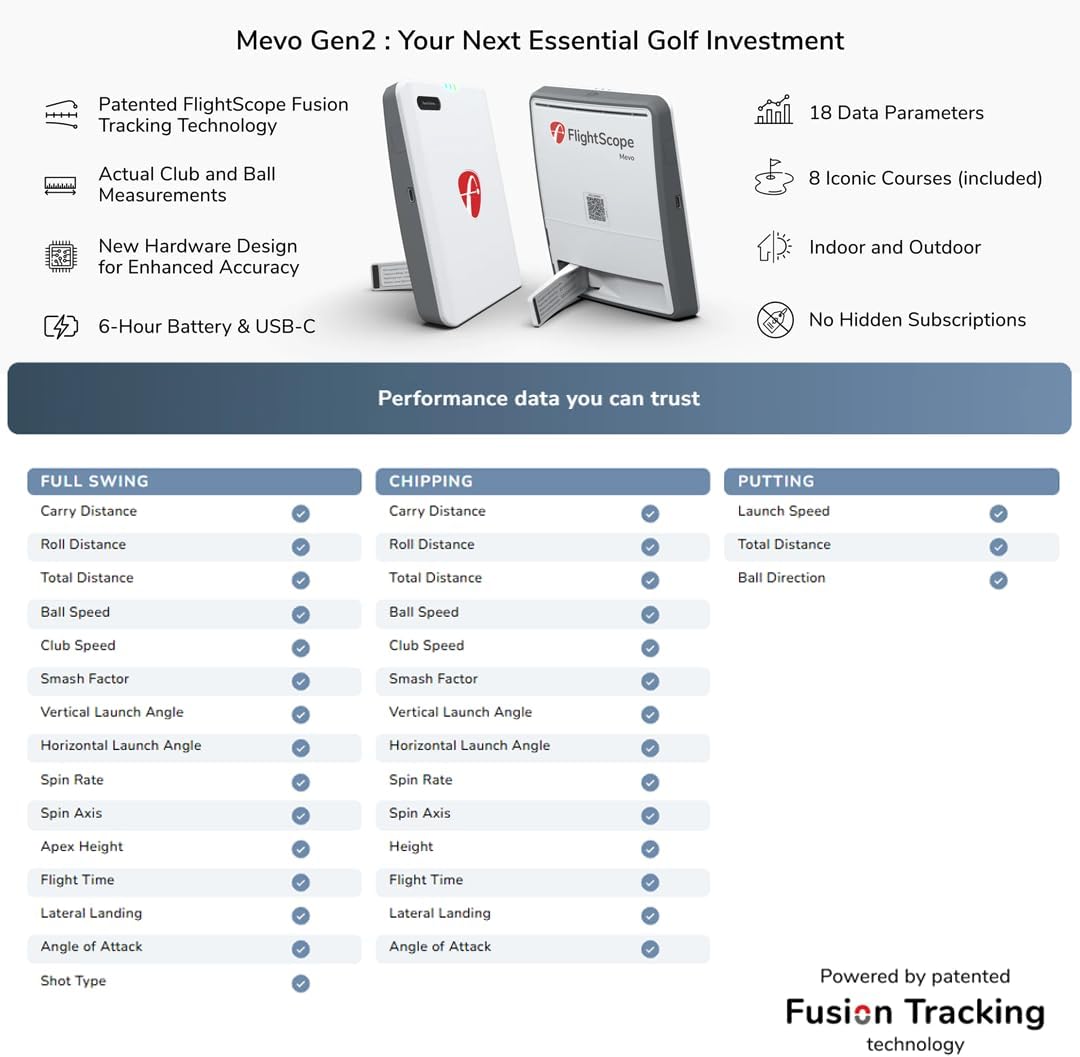
FlightScope
$1,299.00
In stock on Amazon
Check price on AmazonThe Software and Subscription Math
This is the line item most buyers undercount, and it deserves its own treatment.
The Garmin R10 locks you into Garmin’s ecosystem. The subscription is required for meaningful feature access, including virtual rounds and full data history. Flexibility to third-party simulation platforms is limited. If you later decide you want to run E6 CONNECT or TGC 2019, the R10’s integration options are narrow compared to the other two devices in this tier.
The FlightScope Mevo Gen2 offers the most flexibility: no mandatory subscription for basic data capture, and open integration with major simulation platforms through those platforms’ own licensing. If you already subscribe to E6 CONNECT or a comparable service, the marginal software cost of adding a Mevo Gen2 may be close to zero — making the effective device premium over the R10 smaller than the sticker prices suggest.
The Uneekor EYE MINI carries the highest software overhead in absolute terms. IGNITE licensing is substantial, and the platform assumes you are building a permanent installation where that cost amortizes over years of regular use. If you are building a room that will see daily sessions, the per-session cost becomes trivial. If the room will sit idle for weeks at a time, the fixed license cost looks less efficient.
The practical summary: Mevo Gen2 wins on software flexibility, EYE MINI wins on data quality, R10 wins on total entry cost for a buyer who stays inside Garmin’s ecosystem.
Fitting Use Cases: Which One Earns Its Place in a Professional Context?
For teaching professionals and club fitters using a device with students and customers, the calculus shifts.
The R10 is honest about what it is: a personal performance tool. Presenting estimated spin numbers as the basis for a fitting recommendation is a professional liability most instructors will not accept. That does not make it a bad device — it makes it the wrong device for that specific application.
The Mevo Gen2 is a legitimate entry-level fitting instrument for outdoor sessions and initial club assessments. Its direct spin measurement gives it defensible footing in casual fitting contexts, with appropriate caveats disclosed to clients about the estimated nature of club-path and face-angle data.
The EYE MINI is the one device in this tier that a fitter can present to a client as a measurement instrument without qualification on the club data. The photometric capture of face angle, path, and impact location is what clients who have done their research expect to see in a fitting report. Plugged In Golf has noted in multiple category reviews that measured club data represents the clearest capability dividing line between consumer and professional-grade hardware — and the EYE MINI sits on the right side of that line.
The Decision Rules
If you want portable, outdoor-first use and a tight budget: The Garmin R10. Go in knowing spin is estimated and the ecosystem is proprietary.
If you are building a first home simulator in a garage or spare room and cannot mount a ceiling unit: The FlightScope Mevo Gen2. The spin measurement and software flexibility make it the most credible radar-based simulator device in this window.
If you own your space, are building a permanent simulator room, and want a device that will still feel adequate in five years: The Uneekor EYE MINI. The photometric data is in a different class than radar at this price, and ceiling-mount permanence removes the alignment friction that accumulates over hundreds of sessions.
If you are a fitter adding a secondary device for outdoor assessments: Mevo Gen2. If you are a fitter building an indoor fitting bay: Start at the EYE MINI and plan your upgrade path to the EYE XO from there — the software and mounting ecosystem are consistent across the product line, which means your IGNITE investment carries forward.
The $350–$1,000 window is genuinely competitive. None of these are bad choices made well. The ones that go wrong are made without answering that first question: what are you actually building?